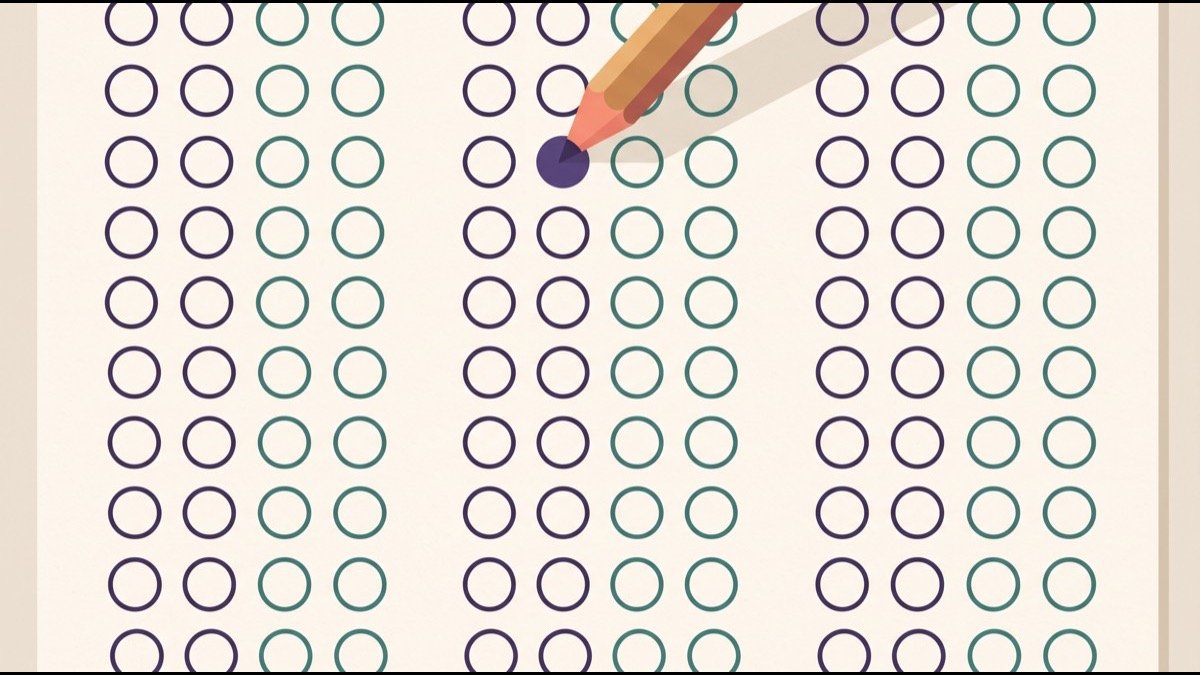
A child can solve the question correctly and still lose the mark by recording the answer incorrectly. That is why separate multiple-choice answer sheets deserve practice of their own.
OMR-style sheets ask candidates to mark a box or oval corresponding to the chosen option. The academic skill may be Maths, English or Reasoning; the practical skill is keeping question numbers and answer positions perfectly aligned.
Always follow the exact instructions provided for your child's current exam, because answer-sheet procedures can vary.
The most common mistake: one-line drift
Imagine the child skips Question 14 but accidentally records the answer to Question 15 on line 14. Every later answer can then be shifted by one.
This is not a knowledge problem. It is a process problem — and it is preventable.
Build a number-check habit
Before marking an answer, the child should briefly match:
Question 23 → answer row 23 → selected option C.
That half-second check feels slow during practice, but it is much faster than repairing a whole shifted section.
Decide how often to transfer answers
Some children prefer marking each answer immediately. Others solve a small group on the question paper and transfer them in batches.
The safer method is the one the child can execute consistently under the official rules and timing. Large batches create more risk of misalignment and leaving answers untransferred at the end.
Practise the chosen routine before exam day.
Erasing and changing answers
If the official sheet requires a particular marking method, teach the child to follow it exactly. When changing an answer, make sure the original mark is dealt with as instructed and the new choice is clear.
Do not invent a correction system on the day.
Skipped questions need a visible system
If a child skips a hard question, they must avoid accidentally filling that row with the next answer. On practice papers, teach them to notice the question number every time they resume.
A simple “question number first” routine is more reliable than trusting memory.
Practise under time pressure
Answer-sheet mistakes often appear when the clock becomes tight. A child who is perfectly accurate during a relaxed worksheet may rush the final five minutes of a mock.
Rehearsing the answer sheet in your target school's own format removes most of the surprise on the day. centre-specific mock papers
Use timed papers with the answer sheet from the start, not only in the final week.
Check without redoing the whole paper
If time remains, scan the answer sheet for blank rows, double marks or suspicious shifts. Compare the last answered question on the paper with the last marked row.
The child does not need to re-solve every question to catch a recording error.
Make the mechanics boring before exam day
The best outcome is that the answer sheet feels ordinary. EduArchives includes mock and multiple-choice practice that can be used to rehearse both subject knowledge and the mechanics of recording answers.
Frequently asked questions
What does OMR mean?
OMR stands for Optical Mark Recognition. It is a method used to read marked responses on a structured answer sheet.
Should my child fill the answer sheet at the end?
That can be risky because time may run out. Use the method recommended for the exam and practise a consistent transfer routine beforehand.
Can answer-sheet mistakes really affect strong students?
Yes. Strong subject knowledge does not prevent misalignment, skipped rows or rushed recording. The mechanics are a separate skill worth rehearsing.