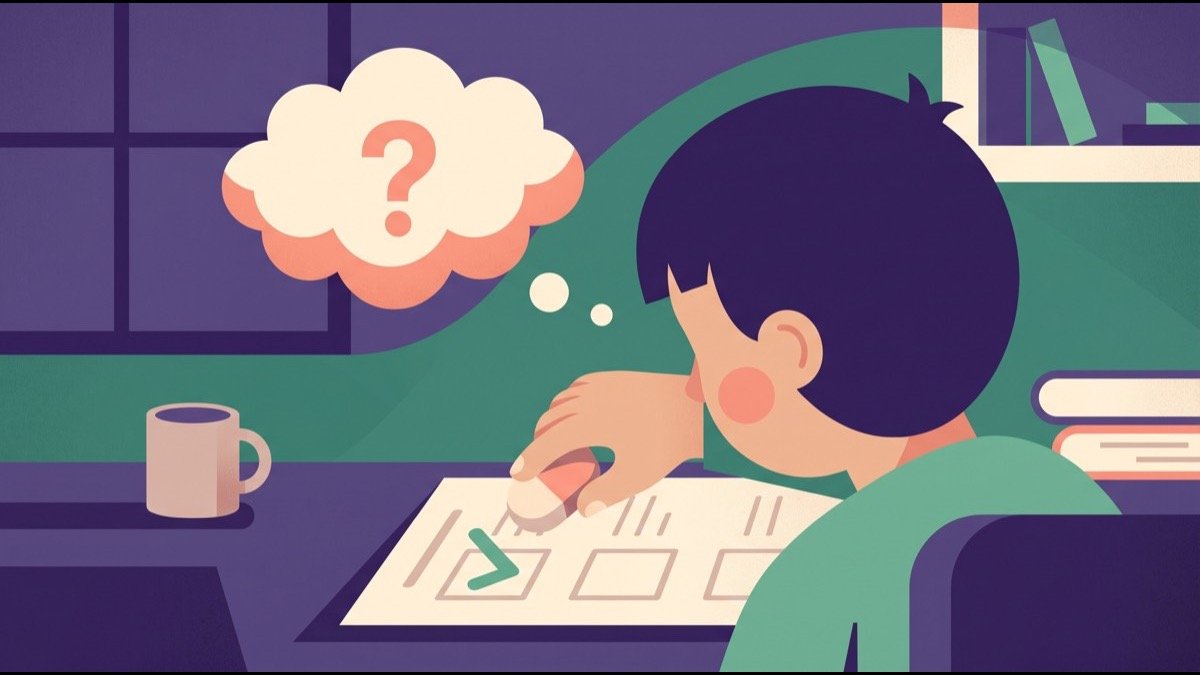
You mark the paper and see the same maddening pattern: a correct option has been rubbed out and replaced by a wrong one. “Why did you change it?” you ask. The child shrugs: “I thought it couldn't be that easy.”
Answer-changing is not automatically bad. Good checking should correct genuine mistakes. The problem is changing without new evidence.
Find out why the answer changed
During review, do not simply say “always trust your first answer”. Ask what caused the change.
Common reasons include:
- noticing a word that was missed;
- recalculating and finding an error;
- anxiety because an answer seemed too obvious;
- seeing a pattern in option letters;
- running out of time and doubting everything;
- confusing a similar question with the current one.
Only some of these are good reasons.
Teach an evidence rule
Before changing an answer, the child should be able to complete the sentence:
Short, low-stakes sheets are an easier place to rehearse the evidence rule than a full paper. free 11+ worksheets
“I am changing this because…”
Examples of valid evidence:
“I reread the sentence and noticed it says NOT.”
“My multiplication was wrong; 7 × 8 is 56.”
“The shape rotates 90 degrees, not 180.”
“I just have a bad feeling” is not evidence.
Track answer changes during mocks
For two or three papers, ask the child to make a tiny permitted practice mark beside any changed answer. When marking, record how many changes went wrong-to-right and how many went right-to-wrong.
This gives you real data about the child's checking style.
Reduce perfectionism
Some strong pupils believe every question should feel completely certain. Multiple-choice exams often require choosing the best-supported option even when two look plausible at first.
Teach them to use evidence and then move on rather than demanding a feeling of total certainty.
Watch for late-paper panic
Poor answer changes often cluster in the final minutes. The child sees time remaining and feels compelled to “improve” something.
Give checking a priority list: blanks, answer alignment, marked doubts, then high-risk calculations. This reduces random tampering.
Do not ban answer changes
“Never change your first answer” can preserve genuine mistakes. The goal is disciplined revision, not stubbornness.
Practise the difference between correction and second-guessing.
Build confidence through explanation
After practice, ask the child to explain several correct answers. When they can articulate the reasoning, they become less dependent on vague feelings during checking.
Practise checking in timed mocks
EduArchives mocks create the right environment to monitor when answer changes help and when they hurt.
Frequently asked questions
Is the first answer usually right?
Not always. What matters is whether a change is supported by better reasoning or newly noticed information.
Should a child mark uncertain answers?
If the exam format permits it, a discreet practice system can help them return efficiently. Follow the rules of the actual test.
How can parents stop overchecking?
Use a fixed checking routine and a reason-before-change rule. Reviewing actual change data from mocks also helps.