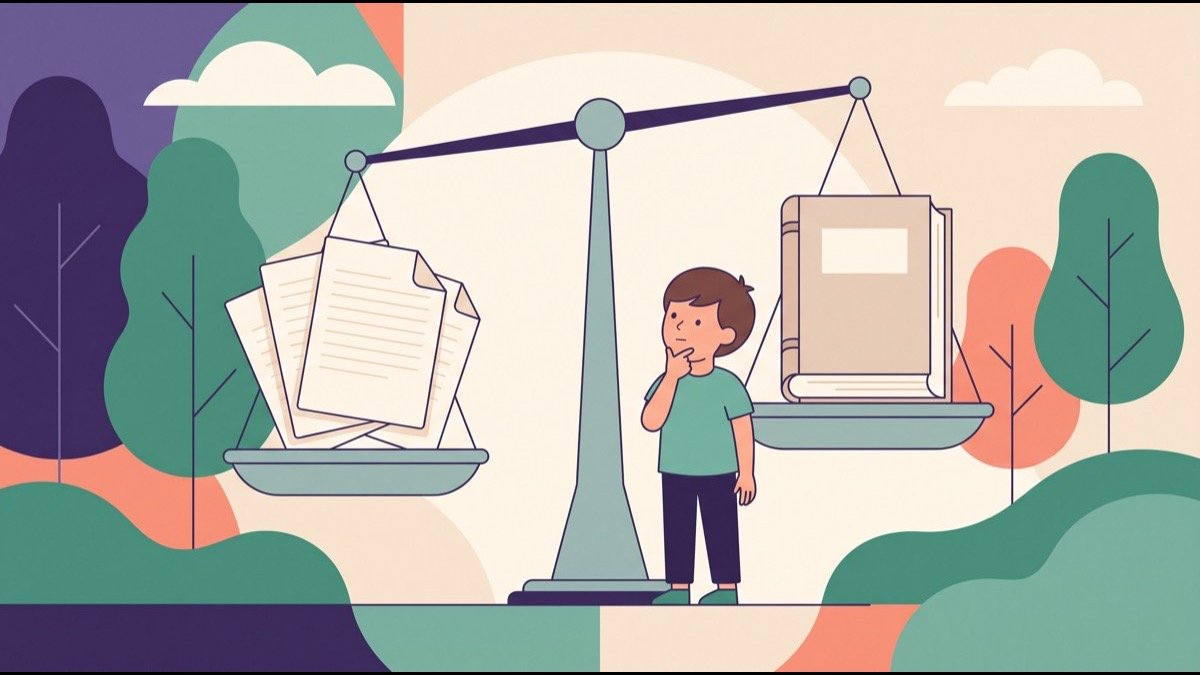
Worksheets and mock papers do different jobs. A worksheet helps teach or strengthen a skill. A mock asks whether the child can choose and use many skills under exam-like conditions.
Problems start when families use one as a substitute for the other.
Early preparation: worksheets should dominate
At the beginning, a child needs to understand methods. Topic-focused work lets them practise fractions without simultaneously worrying about vocabulary, rotations and the clock.
This stage is ideal for building arithmetic fluency, comprehension techniques, grammar knowledge and reasoning familiarity.
Use a few mixed diagnostic questions to identify gaps, but do not make every session a score event.
Middle preparation: start mixing
Once the main methods are familiar, use mixed worksheets and timed sections. The child must learn to identify the topic without being told in advance.
This is where “I can do ratio when the worksheet says Ratio” becomes “I can spot that this word problem requires ratio.”
An occasional mock is useful for measuring transfer.
Later preparation: mocks become more important
Closer to the exam, children need stamina, pacing, section management and answer-sheet familiarity. Full timed papers are the best rehearsal for those skills.
At this stage a full paper under timed conditions is the most realistic rehearsal available. free timed mock papers with marking schemes
However, every mock should still lead back to targeted practice. If a mock reveals weak punctuation, use a punctuation worksheet. If it reveals unfinished NVR, practise timed NVR sets.
The process should loop: mock → diagnose → worksheet → re-test.
What worksheets cannot tell you
A child may score brilliantly on untimed topic sheets but struggle to switch methods or work fast enough. Worksheets rarely reveal the full effect of exam pressure and fatigue.
That is why a child needs some realistic timed practice before the real test.
What mocks cannot teach efficiently
A 60-question paper is a clumsy way to teach one fraction method. The child may encounter only two relevant questions and wait days for another example.
Focused worksheets provide repetition, explanation and a clearer learning target.
A balanced weekly pattern
In a middle stage of preparation, try:
- two targeted worksheet sessions;
- one mixed/timed section;
- one review session or short mock segment.
Closer to the exam, replace one worksheet session with a full mock, then use the next sessions to repair the findings.
Use difficulty deliberately
Do not automatically choose the hardest worksheets because the target school is competitive. Secure basics produce marks. Stretch material is valuable when it builds on a solid method.
EduArchives provides worksheets by subject and level plus separate timed mock libraries, so you can move between teaching and testing without treating them as the same thing.
Start with targeted worksheets →
Then test the transfer: mocks
Frequently asked questions
When should my child start full mocks?
When the main question types are reasonably familiar and there is value in testing timing, stamina and mixed application.
Are mock papers enough on their own?
Usually not. Without targeted repair, a child can repeat the same errors from one mock to the next.
Should worksheets be timed?
Some can be, but first make sure the method is accurate. Timing should strengthen fluency, not train rushed mistakes.